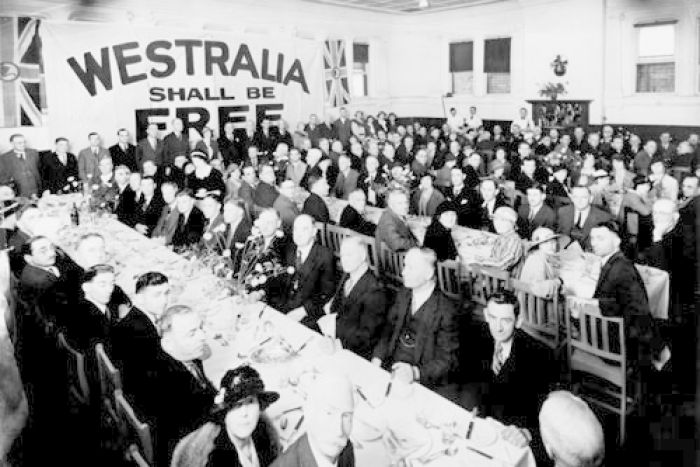
A group of West Australian Liberals has put
secessionism back on the agenda, with a renewed push for the state to
consider becoming an independent nation.
This week's WA Liberal conference will examine setting up a committee to consider secession, amid anger over the state's low GST share. But
experts say the cost of setting up armed forces from scratch and
funding a public health system in its entirety — as well as the
practical aspects of leaving Australia — make it unrealistic. So if WA actually wanted to secede, how would it go?
What is actually being proposed?
The Liberal Party's Brand Division wants a 'WAxit' committee set up to seriously look at secession. It
would examine the option of "Western Australia becoming an independent
state within the Commonwealth" and would report back by mid next year. The Liberal state conference will consider the motion this weekend. But
even any recommendations in favour of secession would not necessarily
have much impact, as motions passed at state conferences are not binding
on Liberal parliamentarians.
Hasn't this come up before?
Yes
— in fact secessionism has been a regular debate ever since WA somewhat
reluctantly signed up to the federation more than a century ago. In 1933, two-thirds of West Australians actually voted to secede, with Perth one of the strongest centres of support. A
delegation was sent to London to convince the United Kingdom's House of
Commons to let WA go it alone, but it refused to consider the matter. Secession movements have come and gone ever since, but none have been as prominent.
"There
is an element who feel the state does get a raw deal from decision
makers in the east," political analyst Peter Kennedy said.
"I think the majority go along with the federation, but from time to time a noisy minority do make their voice heard."
Can states secede from Australia?
The
Australian Constitution describes the federation as "one indissoluble
Federal Commonwealth", strongly suggesting states cannot secede. That is one reason constitutional experts have long dismissed the prospect of secession as unrealistic.
"There isn't an obvious way in which a state can legally secede from
the whole of Australia," Melbourne University constitutional law expert
Cheryl Saunders said two years ago. Most likely, a serious
secession attempt would need to start with a vote in favour in WA — but
exactly what would need to happen beyond that is unclear.
What other difficulties are there?
If
Western Australia became its own country, like any other nation it
would need to fund its own military, print currency and give its
citizens passports. An independent WA would also need to fund its
health and education systems on its own, set up embassies across the
world, pass laws for countless issues currently covered by Federal
Parliament and establish intelligence agencies. Because of those issues, the prospect of secession is seen as unrealistic for financial reasons as much as anything else.
"I doubt whether it is economically viable for WA to secede, above anything else," Mr Kennedy said.
"Even with our stronger financial position with resources, I don't think we'd have the financial resources to do it." WA
would also be left to compete on its own in international sport,
potentially pitting it against Australia in events such as international
cricket and football World Cup qualification. ---------------------------------------------------
WA Liberal Party votes for watered-down secession motion
WA Liberal Party members have passed a WAxit motion for a committee to examine if the state could become financially independent.
The motion was put forward at the party's state conference by Rick Palmer from the brand division who argued WA was getting dudded by Canberra.
"It wasn't a brainstorm one morning, this came out of the fact that a group of us had been talking to people expressing an anger at the way the federation's treating Western Australia," he said.
"It doesn't just go to the GST. We send a significant amount of revenue in the form of income tax ... capital gains tax, superannuation contributions' tax all goes to Canberra.
"Our premiers and our treasurers go over there like Oliver Twist and come back with an empty begging bowl.
"It's not reasonable and something has to change."
The motion called for the state council to establish a committee with three former members of Parliament and three members of council to "examine the option of Western Australia becoming a financially independent state".
The motion did not initially contain the word "financially" but an amendment was passed to make it "financially independent".
WA Liberal leader Mike Nahan voted against the motion.
"There is absolutely no doubt that federation that has evolved over the last many decades is doing well by Western Australia, indeed the nation," Dr Nahan said.
"I can't argue with all those points about the unfair allocation of money withdrawn from the state.
"But ... we're like a family, someone told me many people who are large families will wish they had single-child family, but that's not possible.
"We are a family, it's a great family, we need to work within the family."
The motion was passed 89 votes to 73.
The committee's response will need to be referred to the State Council by July next year.
Opponents worried about 'lunatic fringe' label
The main arguments in the "yes" camp centred around the level of discontent members were hearing from the community.
"They are furious, they're ropeable, these are the members in our branches that we have to convince to re-join because they're so angry with the lack of action," one member said.
But the "no" voters were worried that the party could be labelled as the "lunatic fringe".
WA Liberal Party state president Norman Moore supported the motion and said it would send a very clear message to Canberra.
"I think it tells them that Western Australians ... are not happy with the way in which Western Australia is being treated," Mr Moore said.
"Now the GST is symptomatic of that, but it is more than that.
"Because we are long way from Canberra we feel that we are being ignored and that our interests aren't being taken into consideration by both sides of politics."
Dr Nahan fought to have the reference "WAxit" removed from the title of the motion but Mr Moore would not budge.
His first speech to the Liberal Party faithful earlier in the day was somewhat overshadowed by the motion.
Dr Nahan used his speech to acknowledge the "mistakes" the party had made that led them to an overwhelming loss in the March election and outlined his plan to woo back voters.
"[WA voters] turned from us to the Labor Party in large numbers," Dr Nahan said.
"Our job is to bring them back. The party of Mike's mates."
First posted 3 Sep 2017 ---------------------------------------------------------------------------------------
The horses of an Argentine polo club may look normal, but the way they came into existence is anything but conventional.
You
don't expect to hear that some of the most cutting-edge biotechnology
is now part of the elite game of polo, "the ancient sport of kings."
But
on a trip to Argentina last December, we went to a big polo match --
and discovered that several of the champion horses on the field were
clones.
It's a big day in Buenos Aires — the final match in this
year's World Cup/Super Bowl of polo called the Argentine Open – with
the usual pageantry, the tango included. In polo, the horses, called
ponies, are just as important as their riders.
The two teams are La Dolfina in white and Ellerstina in black.
Adolfo Cambiaso CBS News
Each team has four players who ride as many as a dozen horses during
matches. All of the players today have reached the highest ranking in
the sport – a 10 goal handicap.
The player generating the most
interest is the man in the blue and white helmet, Adolfo Cambiaso. He's
led his team to victory for the last five years. At 42, he's the Tom
Brady of polo.
Adolfo Cambiaso: I love the sport that I do. I love polo. I love horses. And so I try to be the best.
Lesley Stahl: You are number one in the world in your sport. That's stunning, isn't it?
Adolfo Cambiaso: It's strange. When they say it to you, you don't feel like it but…
Lesley Stahl: How long have you had this title? How many years?
Adolfo Cambiaso: For 22 years.
Lesley Stahl: You've been the best in the world for 22 years?
Adolfo Cambiaso: That's what they say.
At
age 25, Adolfo decided to create his own polo team called La Dolfina,
and a breeding business from scratch. Today he has nearly a 1000 horses
that are fed a special diet of plants and grasses grown on his massive
farms.
Adolfo Cambiaso: If they have a little pain somewhere I dig a swimming pool for them just to swim.
A swimming pool for the horses, where they do laps and stretch out their sore muscles.
Lesley Stahl: And they like it?
Adolfo Cambiaso: They love it.
Lesley Stahl: They do? They like to--
Adolfo Cambiaso: They love it. They jump on. It's amazing.
His
most prized horse for a long time was named Aiken Cura. But at the
Argentine Open 12 years ago, Aiken Cura's leg was broken. And Adolfo was
devastated.
Adolfo Cambiaso: More than anything, I say, "Save this horse."
Lesley Stahl: He was your favorite--
Adolfo Cambiaso: Yes.
But the horse could not be saved. Before they put him down, Adolfo
made a fateful decision: he asked his veterinarian to save some of the
horse's skin cells. He thought that one day he could bring Aiken Cura
back to life through cloning.
Adolfo Cambiaso: I was really sad and I say cloning should work --
Lesley Stahl: How did that come into your head?
Adolfo Cambiaso: I don't know. I decided to keep some cells from him, just in case years later-- cloning-- is normal.
He
remembered Dolly the sheep, the first cloned mammal. Since then,
scientists have cloned cows, pigs, goats, and in 2003, the first horse.
Biologist
Adrian Mutto, one of the first scientists to clone in Argentina, showed
us the process: he starts with an egg extracted minutes earlier from a
mare.
Dr. Adrian Mutto: You can see here, this is an egg. And with that needle, we eliminate all DNA of each egg.
Next, he replaces it with the DNA of the horse they want to clone.
Dr. Adrian Mutto: The next step is introduce again into the, into the egg the needle. This is the DNA into the egg.
Lesley Stahl: You did it?
Dr. Adrian Mutto: Yeah This is our cell and this is the egg.
Lesley Stahl: And that's it.
Dr. Adrian Mutto: That's it.
The new embryos are then incubated for one week. No sperm has been involved.
Dr. Adrian Mutto: We don't need the sperm.
Lesley Stahl: There's no male--
Dr. Adrian Mutto: Yes. Yes, no male here. Only me.
Lesley Stahl: But-- but that's incredible. The-- there-- it's-- so it's not a male-female reproduction at all.
Dr. Adrian Mutto: Yes.
Lesley Stahl: You're just taking a cell from whichever. Could be a mare or could be a male horse--
Dr. Adrian Mutto: Yes.
Lesley Stahl: And you're putting it in this egg--
Dr. Adrian Mutto: The cell, into the egg.
Lesley Stahl: No sex at all?
Dr. Adrian Mutto: And-- we, no. Poor horses.
The incubated egg is implanted in a surrogate mare who gives birth to the clone –- like this one that's 3 weeks old.
Cloning
represented a business opportunity to this man, Texas oil heir and polo
enthusiast Alan Meeker. He had long dreamt of building a fleet of
champion horses, and now had a way to do it.
Alan Meeker: I did
some short math and I realized it would take 50 years and about $100
million to do what I wanted to do. And I thought, "Well, why don't I
just clone a bunch of horses, really, really good horses.
In 2009,
Meeker founded a horse-cloning business and, a year later, licensed the
technology that was used to clone Dolly the sheep.
Alan Meeker:
"Okay, now-- now I need to find the best horses." So I put together an
idea of licensing the genetics from the very best-- breeders in polo. I
knew some people that knew Adolpho.
Lesley Stahl: Was he considered one of the best breeders? Not just the best players, but also one of the best breeders?
Alan Meeker: Breeders and owners of horses. His horses were performing better than anyone else.
Lesley Stahl: When Alan first approached you about cloning?
Adolfo Cambiaso: And I say yes the first day.
Lesley Stahl: Immediately.
Adolfo Cambiaso: Yes.
Lesley Stahl: And, "Guess what," you said, "Alan, guess what I have"?
Adolfo Cambiaso: Yeah. I wanna tell him that I have-- cells from a horse that I really loved that I would love to clone.
It took a while to get it right – one attempt failed, but after two
years, Adolfo got his wish. The birth of a clone of his beloved Aiken
Cura who grew into this magnificent, healthy horse, almost exactly like
the original in strength, athletic ability and temperament.
Adolfo Cambiaso: When I saw him, I couldn't believe it.
Lesley Stahl: Did you know by just looking-- and of course it was a little foal at that point--
Adolfo Cambiaso: Yes. It was. But…
Lesley Stahl: You could tell?
Adolfo Cambiaso: To make sure, I took some hair from him, and I bring him back to Argentina to do the DNA.
Lesley Stahl: To double-check.
Adolfo Cambiaso: To double-check it was him.
At the same time, he decided to clone another horse -- his biggest star -– a mare called Cuartetera.
Now
17 years old, the original has been playing polo since she was 4 - a
year younger than most polo ponies – simply because she took to the game
so quickly.
Adolfo Cambiaso: I think she's
born to play, you know? There is those horses in life or like soccer
players like Messi. It's not many.
Lesley Stahl: Like you.
Adolfo Cambiaso: No. I don't know. No. But what I'm saying, this horse is amazing.
He took us to the barn where Cuartetera lives with eight of her clones.
Adolfo Cambiaso: You see those-- these two little points--
Lesley Stahl: Yeah.
Adolfo Cambiaso: From this little point is where you make all these horses.
Lesley Stahl: This is where they took the cells—
Adolfo Cambiaso: Exactly.
Lesley Stahl: --to make the other--
Adolfo Cambiaso: To make the other. Because of her you get all these ones.
Lesley Stahl: And that was what you were thinking?
Adolfo Cambiaso: Yes.
Lesley Stahl: "I'm gonna"--
Adolfo Cambiaso: That was my dream but everybody was--
Lesley Stahl: --"clone the best."
Adolfo Cambiaso: --saying that I was crazy. And I like it right now because I'm having a good time hearing those people.
Lesley Stahl: Yeah, they're saying, "He's not so crazy anymore"-
And look what he's done: in seven years, he and his partners have created more than a dozen clones of Cuartetera.
Dr. Adrian Mutto: It's incredible for me. I never lose my, wow, this is-- my production. This is my equine daughter.
Dr.
Mutto, who was hired as the lead scientist in Adolfo's cloning
business, took us to see the Cuartetera clones he thinks of as his
children.
Dr. Adrian Mutto: This is-- Cuartetera number five.
Lesley Stahl: Oh my God.
Dr. Adrian Mutto: This is number four. Number three. Number nine.
Lesley Stahl: Oh my God.
Dr. Adrian Mutto: Number six.
Lesley Stahl: You can tell which one.
Dr. Adrian Mutto: Yeah, be--
Lesley Stahl: You're not reading anything--
Dr. Adrian Mutto: --because I know her by the-- but-- they are-- are all clones.
Dr. Adrian Mutto: Yes. Right now, we have 14.
Lesley Stahl: Just from Cuartetera?
Dr. Adrian Mutto: 14, and next year, 10 more. And 2019, 10 more.
In
all, there are more than 100 clones from several of their best horses.
In each case, he said the clones are strikingly similar to the originals
in disposition, athletic ability and appearance. But not exactly. For
example, the Cuartetera clones all have white markings, but with
different shapes and in different places, some on the face; some on the
ankle.
But all the Cuarteteras seem to have inherited the original's calm, self-contained personality.
Lesley Stahl: So the genetics include this temperament?
Adolfo Cambiaso: Yes.
Lesley Stahl: And do the clones get along with each other?
Adolfo
Cambiaso: Yeah, because they live together all year long. So-- from
here, they go to the farm together, then they move in blocks. If you
take one out of them, they are looking for it.
Lesley Stahl: They miss the one that you take out.
Adolfo Cambiaso: Yeah.
Lesley Stahl: Did the clones have any special health issues?
Adolfo Cambiaso: No.
We
talked to scientists at the National Institute of Health and were told
there is no evidence that cloned animals suffer disproportionate health
problems, though they have a slightly higher infant mortality rate. At
first, many of Adolfo's cloned embryos died during gestation. But they
refined their technique and now tell us they have an 85 percent
successful birth rate and have not experienced any health problems.
Lesley Stahl: So as far as you are thinking, they're exactly the same in health, longevity.
Adolfo Cambiaso: Si.
Lesley Stahl: Ability to play the game, all of it.
Adolfo Cambiaso: Similar. Similar. Not exactly the same…
Lesley Stahl: What are the differences?
Adolfo
Cambiaso: There is some that are a little bigger. Some eat more, some
eat less. Or they move a little bit different. But the mind are really
similar. The good thing about it, they are machines, all of them.
Machines -– that's polo talk for horses that never quit.
But
how would they perform in competition? At the final at the Argentine
Open, Adolfo gambled that his Cuartetera clones would be as good as the
original and, for the first time, he rode them almost exclusively.
Regulators
of thoroughbred horse racing worldwide have taken a firm stand against
cloning. But there is no such prohibition in polo and so cloning is
spreading to teams beyond Adolfo Cambiaso's. It raises some thorny
questions: does cloning give a team an unfair advantage? Is it ethical?
And where will it lead?
In December, at the final match of the
Argentine Open in Buenos Aires, one team rode clones while the other
refused to. The competition was as much about the merits of cloning as
it was a sporting contest.
Out of more than 850 professional
polo players, Argentine native Adolfo Cambiaso – wearing the blue and
white helmet and the jersey marked number one, is the best player in the
world. He's held that ranking for 22 years and is now leading a cloning
revolution. He's cloning his best horses; the one he's riding is a
clone. He's competing on them – and winning.
Lesley Stahl: When
you're on one of the clones playing, is there a special feeling? Knowing
that h-- you know, this is something that was your idea, you brought it
to life--
Adolfo Cambiaso: Yeah. In this stage of my career-- the
last couple of years for me to play and prove that the clone works and
play with Cuarteteras and everything is an extra motivation for myself,
for sure.
Lesley Stahl: I don't know that you need extra motivation.
Adolfo Cambiaso: Yeah, I do. I do.
He's
created 14 clones of Cuartetera, his very best horse – a 17-year-old
mare who is fast, easy to direct and can turn on a dime. She was honored
last year as the best polo horse in history. Her clones seem to be just
as gifted.
Lesley Stahl: Are they all as good – I want to call her Mama. I don't–- That's probably not the right word.
Adolfo Cambiaso: The original. Yeah.
Lesley Stahl: Are they as good?
Adolfo Cambiaso: I already won two Argentine Opens with the clones. So they will end up being as good as her I think.
Cuartetera's clones are identified by numbers.
Lesley Stahl: Shouldn't they have names?
Adolfo Cambiaso: They have names.
Lesley Stahl: Well, they don't.
Adolfo Cambiaso: Cuartetera.
Lesley Stahl: Yeah, but-- m--
Adolfo Cambiaso: Cuartetera one, two, three, four--
Lesley Stahl: Was that your idea?
Adolfo Cambiaso: Yes. Because I-- I believe that she is a Cuartetera. All of the ones that I ride, they are Cuarteteras.
Lesley Stahl: So you actually think--
Adolfo Cambiaso: She's Cuartetera when I play.
Lesley Stahl: When you're-- so six is Cuartetera, is--
Adolfo Cambiaso: Is Cuartetera.
Lesley Stahl: And when you're on nine, it's the same thing?
Adolfo Cambiaso: Cuartetera.
Lesley Stahl: But she's an individual.
Adolfo Cambiaso: Yes. But the DN-- DNA, it's a Cuartetera.
Lesley Stahl: But when you have identical twins, they each get a name.
Adolfo Cambiaso: But this is not twins, it's a clone. They
can now create 100 clones a year and they're using them in Adolfo's
already successful breeding business. They mate the clones with champion
horses and sell their foals ( 指的是未滿一歲的小馬, 公的叫colt , 母的叫filly) for up to $250,000. But they never sell the
clones.
Adolfo Cambiaso: You sell the clone, you sell the blood,
you sell the line, you sell the DNA, you sell everything if you sell a
clone.
Ernesto Gutierrez: We keep the key of the genetics and this was, I think, the good business to make that decision in the past.
The
idea of never selling the clones came from Ernesto Gutierrez, a shrewd
Argentine businessman, who became a third partner in the cloning
venture. The cloning operation was set up here on his 500-acre property
outside Buenos Aires that includes three polo fields, and a nursery
where the clones are born. They are carried by surrogate mares who treat
them like their own.
Lesley Stahl: Are these all cloned babies in here?
Ernesto Gutierrez: All cloned babies? Yeah.
Lesley Stahl: And these are the surrogate mothers? And does the mother think it's totally her baby?
Ernesto Gutierrez: Totally, totally. Look at that.
Gutierrez took us back to see the newest one – that 3-week-old clone of Cuartetera who has her own nurse.
Lesley Stahl: Oh, look how sweet. And frisky. Oh, look at that, oh my.
Not
everyone in polo thinks cloning is a good idea - including Adolfo
Cambiaso's main rival and opponent at the final of the Argentine Open.
Facundo
Pieres: There's a lot of guys cloning. But I think that they have to be
careful, you know because, the thing is that they're opening too much,
you know? I mean--
Lesley Stahl: Pandora's Box. You know what that means? They let-- opened the lid. And all the problems come out—
Facundo Pieres: Exactly.
Facundo
Pieres is number two in the world, right behind Adolfo. He showed us
what he can do, like dribble a three-inch ball in the air while
galloping down the field 20 miles an hour. He's the captain of
Ellerstina, an old-school team made up of three brothers and a cousin.
They are committed to keeping it a family enterprise.
Lesley Stahl: Do you ever get angry at each other?
Facundo Pieres: Yes. Yes, but in a good way. Never-- never bad.
His
team is headquartered at another sprawling estate where they operate a
multi-million dollar breeding business selling foals and embryos. They
believe they can produce better horses through their breeding practices -
by mixing the DNA of two different horses, rather than by replicating
just one.
Facundo Pieres: We wanna keep it this way. What we have here is amazing
Lesley Stahl: In polo, what's more important, the horse or the player? I was told that it's 80 percent the horse. Sorry--
Facundo Pieres: Yes, I-- I agree. No--
Lesley Stahl: No offense.
Facundo
Pieres: No, I agree. I agree. I totally agree. I think that the horse
is. But of course, you need to have a little bit of-- of talent and
ability and-- and experience in the head, you know?
Facundo's team
– Ellerstina - has made it to the finals the last 4 years, but lost
each time to Adolfo Cambiaso's team. Fueling the rivalry on the field is
a bitter history between them: Adolfo played on the Ellerstina team for
9 years.
Adolfo Cambiaso: Because of what happened, that I left Ellerstina and the rivalry is there--
Lesley Stahl: Intense.
Adolfo Cambiaso: Yeah.
Lesley Stahl: To this minute.
Adolfo Cambiaso: Yeah.
Lesley Stahl: Do you feel it too?
Adolfo Cambiaso: But it's fun.
Lesley Stahl: Oh, you like it--
Adolfo Cambiaso: You gotta have rivalry to be better player too.
There's
more. Before he left Ellerstina, Adolfo bought Cuartetera, as an
embryo, from the Pieres family… the very horse he is now cloning to
compete against them.
Adolfo Cambiaso: I was lucky to end up with Cuartetera.
Lesley Stahl: You cloned from the best horse in the world.
Adolfo Cambiaso: But she's born on my farm. I create her.
Lesley
Stahl: There are people who object to cloning on religious grounds… Or
on moral grounds. So what is the answer when people challenge you? When
they say, 'Man should not be doing this' because of these difficult
spiritual questions?
Adolfo Cambiaso: I don't see it, I don't
see it wrong, to be honest. I'm just-- doing something for-- to improve
my game, my sport. And I think the Cuateteras did improve my game, my
sport. And I'm not going farther than that.
Lesley Stahl: But, is there an unfair advantage in terms of the game, in terms of the sport?
Adolfo
Cambiaso: No, because everybody's able to clone. Now everybody's kind
of trying to start cloning. So the advantage is that I did it seven
years ago.
Lesley Stahl: So in 30 years, people will still be riding Cuartetera?
Adolfo Cambiaso: Yes.
Lesley Stahl: And so it could go on forever.
Adolfo Cambiaso: Yes. Yes.
Alan Meeker, the Texas businessman who is Adolfo's cloning
partner, is well aware of the controversy around cloning technology in
the U.S. and the ban against it in thoroughbred horse racing.
Lesley
Stahl: Is a really good polo player-- does he have-- an unfair
advantage if he's on a clone of one of the best-- polo horses ever?
Alan
Meeker: Of course. Horses are 80 percent of the game anyway. So if
Facundo Pieres finds a horse that is better than Cuartetera than he has
an advantage over his competitor.
Lesley Stahl: But he'll have
only one. And that horse will get tired, and he'll have to switch to
another horse in the game, whereas Adolfo will have 8.
Alan Meeker: Right.
Lesley Stahl: So it's still an advantage.
Alan Meeker: Right.
Lesley Stahl: Is that fair?
Alan Meeker: Under the rules it's fair. There's no restriction on…
Lesley
Stahl: I know but the game — but sportsmanship, just the nature of the
game. Has this changed the very essence of the game of polo?
Alan Meeker: No. I think what it's done is probably raise the bar.
Lesley Stahl: You're going to have to clone.
Alan Meeker: Could be. Yes.
Lesley Stahl: Do you have any moral problems with cloning a human being?
Alan
Meeker: Yes. I disagree with it. I know a good reason, lots of good
reasons to clone-- body parts, like hearts and lungs and pancreases, if
it could be done in a productive manner, that can save lives. But I've
been asked by some of the wealthiest people on planet earth to clone a
human being and we--
Lesley Stahl: You have?
Alan Meeker: Absolutely.
Alan Meeker: And the answer is always-- a resounding "no."
Lesley Stahl: Well, they must have a reason.
Alan Meeker: And they won't give it to me.
Lesley Stahl: They don't tell you why?
Alan Meeker: No.
Lesley Stahl: I'm thinking if science can do it, science will
do it and maybe one day, you know, they'll be clones and we'll laugh at
all the people who were questioning the morality of it now.
Alan Meeker: Someday someone will do it--
Lesley Stahl: Yes.
Alan Meeker: And we will either laugh or we will cry. But I'm not gonna be the one to take that-- that leap.
Lesley Stahl: It could be done today.
Alan Meeker: Yes.
Lesley Stahl: I assumed there'd be a big difference between a horse and a human. Lots of differences.
Alan Meeker: Surprisingly little. Yeah. Surprisingly little.
At
the final match at the Argentine open, Adolfo's team and the clones
were expected to win, but seven minutes in, Facundo's team was ahead,
three goals to one.
Adolfo's team fought back; at halftime, the
score was, the cloners, 7; the breeders, 6. It was so tense that at
times it was as quiet as a tennis match.
The end of the game was
thrilling: as expected, Adolfo's team was ahead, 13 to 10, but then
Facundo's team in a final blast came back to tie the match.
Adolfo Cambiaso: I never think I'm-- I gonna lose. I never.
Lesley Stahl: Well, we saw you right before the overtime.
Adolfo Cambiaso: Yeah.
Lesley Stahl: And here you are. Like that.
Adolfo Cambiaso: In that moment, I was trying to think, "Which is the best horse for that moment?"
He debated, should it be Cuartetera 9? Or 5? Finally he picked number 6.
In the first minute of the sudden death overtime, Facundo's team lost control of the ball.
Adolfo's team recovered and Adolfo on his mighty Cuartetera 6 outran everyone and whacked the ball setting up the winning shot.
Watching, you had to wonder: was it the clones or the world's best player that made the difference?