Venture may cost $200 billion, add 100,000 jobs in the kingdom
Plan envisions 200GW of solar capacity in Saudi Arabia by 2030 Saudi Arabia and SoftBank Group Corp.
signed a memorandum of understanding to build a $200 billion solar
power development that’s exponentially larger than any other project.
SoftBank
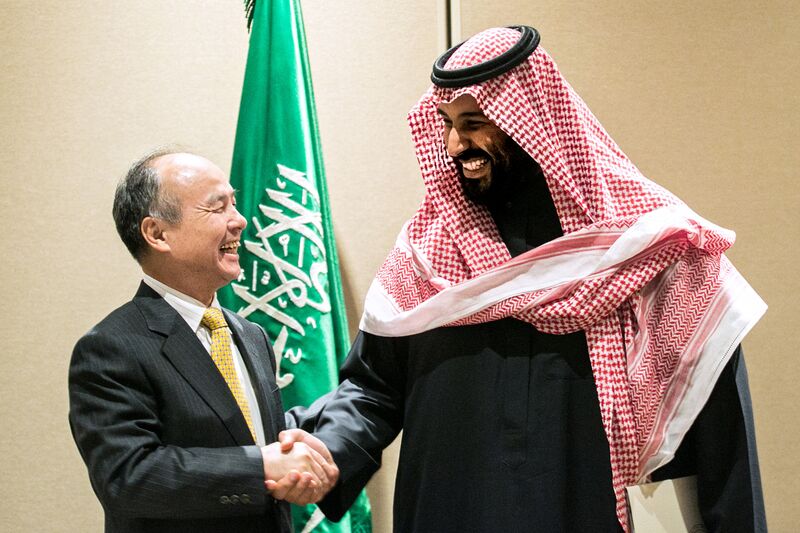
founder Masayoshi Son, known for backing ambitious endeavors with
flair, unveiled the project Tuesday in New York at a ceremony with Saudi
Crown Prince Mohammed Bin Salman. The powerful heir to the throne of
the world’s largest crude exporter is seeking to diversify the economy
and wean off a dependence on oil.
Masayoshi Son and Mohammed bin Salman.
Photographer: Jeenah Moon/Bloomberg
The
deal is the latest in a number of eye-popping announcements from Saudi
Arabia promising to scale up its access to renewables. While the kingdom
has for years sought to get a foothold in clean energy, it’s was only
in 2017 that ministers moved forward with the first projects, collecting
bids for a 300-megawatt plant in October.
At 200 gigawatts, the Softbank project planned for the Saudi
desert would be about 100 times larger than the next biggest proposed
development and more than double what the global photovoltaic industry
supplied last year, according to data compiled by Bloomberg New Energy
Finance.
“It’s a huge step in human history,” Prince Mohammed said. “It’s bold, risky and we hope we succeed doing that.”
Over The Top
SoftBank-Saudi solar vision dwarfs other planned PV projects
If built, the development would almost triple Saudi
Arabia’s electricity generation capacity, which stood at 77 gigawatts in
2016, according to BNEF data. About two thirds of that is generated by
natural gas, with the rest coming from oil. Only small-scale solar
projects working there now.
Son said he envisions the project,
which runs the gamut from power generation to panel and equipment
manufacturing, will create as many as 100,000 jobs and shave $40 billion
off power costs. The development will reach its maximum capacity by
2030 and may cost close to $1 billion a gigawatt, he said.
“The
kingdom has great sunshine, great size of available land and great
engineers, great labor, but most importantly, the best and greatest
vision,” Son told reporters at a briefing.
Deepening Ties
The agreement deepens SoftBank’s ties with the Saudi Arabia, and advances the crown prince’s ambition to diversify its economy.
“SoftBank
seeks investment and Saudi needs energy, so it may make sense to sort
the financing out in a large block and then separately hammer out the
phases and the technical details,” said Jenny Chase, head of solar
analysis at BNEF. “It is worth noting that many of these memorandums of
understanding do not result in anything happening. ” SoftBank was said
to be planning to invest as much as $25 billion in Saudi Arabia over
the next three to four years. That’s a boost for Prince Mohammed, who’s
been at the forefront of the Vision 2030 campaign to diversify the
kingdom’s economy away from oil by that year. SoftBank is said to have
aimed to deploy as much as $15 billion in a new city called Neom, which the crown prince plans to build on the Red Sea coast.
The Japanese company’s Vision Fund is also said to plan investments of as much as $10 billion in state-controlled Saudi Electricity Co. as part of efforts to diversify the utility into renewables and solar energy.
Vision, Investments
Son, who is known as a savvy investor with a flair for the spotlight,
has been promoting clean energy since the 2011 Fukushima nuclear
disaster and recently completed a 50-megawatt wind power farm in
Mongolia. He has also pushed a plan dubbed “Asia Super Grid,” a plan to
connect Asian nations by grids and undersea cables to distribute clean
energy.
The kingdom’s deal-making has quickened as it pursues
Prince Mohammed’s diversification goals. Saudi Arabia’s sovereign wealth
fund, the Public Investment Fund, which has more than $224 billion in
assets, spent about $54 billion on investments last year. The sale of
about a 5 percent stake in oil giant Saudi Arabian Oil Co. is expected
to provide more funds.
Saudi Arabia also plans
to build at least 16 nuclear reactors over the next 25 years at a cost
of more than $80 billion. Electricity demand in the country has risen by
as much as 9 percent a year since 2000, according to BNEF. — With assistance by Chisaki Watanabe, and Stephen Stapczynski
Eric Chan, @erichankchttps://chinese.engadget.com/2016/03/10/co2-solar-batteries-general-electric
有兩個問題纏繞著環境科學家多個世紀,一是如何把太陽能電力儲存;二是如何處理因為燃燒碳而產生的 CO2。通用電氣(GE)的科學家想到了一個一石二鳥的方法,就是利用 CO2 作為巨型電池來儲存多餘電力。做法類似在加州的 Ivanpah 太陽能發電廠,利用鏡子集中反射太陽熱力至中央的鹽(GE 未有指出是哪種類的鹽)。同時,CO2 將會在地下儲存,把多餘的能源以固體乾冰的狀態儲存。 當在用電量高峰的時候,電廠就能利用燒熱的晶體把固態的 CO2 加熱至「超臨界(supercritical)」的狀態。這些介乎氣態與固態之間的 CO2 就能用作推動渦輪機發機。下圖所示的 Sunrotor 原型模型,在 GE 把它正式建造出來後,據稱將能為 100,000 戶家庭提供電力。
A solar thermal power concentrates heat from the sun to boil water and use the steam to generate electricity. Image credit: Getty Images
GE researchers have developed a new technology that uses CO2 to generate a substantial amount of clean energy, and it doubles as an energy storage solution for solar panels. CO2, of course, is one big cause of climate change, and the irony isn’t lost on GE. By using the technology, solar storage and clean energy could be made more efficient while simultaneously reducing the amount of fossil fuels needed to power homes and dealing with harmful CO2 pollution wrecking the environment.
In a statement on Tuesday, GE detailed the work of Stephen Sanborn, a senior engineer with GE Global Research and the principal investigator for this project. The issue concerns energy demands that come at times when solar is not ideal, and presents a way to store surplus energy when the weather is more than ideal. During the long dark days of winter, for example, having a surplus of energy is necessary to meet demand. During the bright, long days of summer, solar arrays may generate more electricity than current technologies can adequately store.
A life-size prototype of GE’s “sunrotor” on a shelf
at GRC. This 10 megawatt prototype is the basis for the full-scale
system which stores 100 megawatt-hours and generates power at 33
megawatt, Sanborn says. Image credit: GE Global Research The solution could be the contraption you see above, a so-called ‘sunrotor’ that functions as a CO2 turbine based on the company’s own steam turbine design. Rather than using steam, though, the sunrotor uses CO2 that is heated from its dry ice stage into a supercritical fluid using molten salt. This particular prototype is able to generate 100megawatts of electricity.
The storage part comes from how the system deals with the CO2 — in this case, solar heat is stored in molten salt, and extra electricity is used to cool CO2 into dry ice. When more electricity is needed than the system is able to provide in that moment, the salt is then used to warm up the dry ice, powering the sunrotor and generating electricity to fill in the gap.
Adding the system to existing solar setups would be simple, according to GE; right now, researchers are focusing on the bringing the cost-per-megawatt down to $100.
General Electric has been increasingly working toward a more green future, and to that end it recently announced plans to focus solely on LED bulbs in the U.S., ditching CFLs 慳電膽 and the problems they present. The time is right, GE had said, as the technology has improved while costs have come down substantially. Though an LED bulb is usually still more expensive than a CFL bulb, they last much longer and, as one example, illuminate at full brightness instantly rather than taking a few minutes to warm up.
Solar power is a great source of renewable energy, but as with many things in life, timing is everything. The sun doesn’t shine on long winter nights when people turn on their lights. On the other hand, a sunny Sunday afternoon can produce an ample electricity surplus that’s difficult to store.
“That’s the grand challenge,” says Stephen Sanborn, senior engineer and principal investigator at GE Global Research (GRC). “We need to make renewable energy available to the grid when it is needed.”
Sanborn and his team decided to solve this problem by storing some of the heat generated by thermal solar power plants in carbon dioxide. These power plants concentrate solar rays with vast fields of mirrors and use the heat to generate steam that spins a turbine. The carbon dioxide effectively works like a battery that can quickly release energy during peak demand.
The irony, of course, is that CO2 is the prime contributor to climate change, and the reason the world is switching to renewable energy in the first place.
The work is part of a research partnership between the GRC and the U.S. Department of Energy. Sanborn says the solution could revolutionize the solar power industry and also make natural-gas power plants more efficient.Here’s how it works. The design has two main parts. The first one collects heat energy from the sun and stores it in a liquid of molten salt. “This is the hot side of the solution,” Sanborn says. The other component uses surplus electricity from the grid to cool a pool of liquid CO2 so that it becomes dry ice.
During power generation, the salt releases the heat to expand the cold CO2 into a supercritical fluid, a state of matter where it no longer has specific liquid and gas phases. It allows engineers to make the system more efficient.
The supercritical fluid will flow into an innovative CO2 turbine called the sunrotor, which is based on a GE steam turbine design. Although the turbine can fit on an office shelf (see image above) it can generate as much as 100 megawatts of “fast electricity” per installed unit—enough to power 100,000 U.S. homes.
Sanborn believes that a large-scale deployment of the design would be able to store “significant amounts” of power —— and deliver it back to the grid when needed. “We’re not talking about three car batteries here,” he says. “The result is a high-efficiency, high-performance renewable energy system that will reduce the use of fossil fuels for power generation.”
He says the system could be easily connected to a solar power system or a typical gas turbine. The tanks and generators could fit on trailers 拖車. His goal is to bring the cost to $100 per megawatt-hour, way down from the $250 it costs to produce the same amount in a gas-fired power plant. “It is so cheap because you are not making the energy, you are taking the energy from the sun or the turbine exhaust, storing it and transferring it,” says Sanborn.
The process is also highly efficient, Sanborn says, yielding as much as 68 percent of the stored energy back to the grid. The most efficient gas power plants yield 61 percent.
The team is now building a conceptual design, which Sanborn believes could take five to 10 years to get from concept to market.
GE is also looking at other commercial applications that could be made available sooner. One such utilizes the waste exhaust heat from a natural gas generator. Sanborn says the solution could make gas-fired power plants 25 to 50 percent more efficient. That, he says, would be a major environmental benefit, because it would significantly reduce the overall CO2 emissions per kW hour of electricity produced by gas-powered plants.
Sanborn’s included in his team turbine experts, thermal engineers who understand refrigeration, heat-transfer scientists, chemical engineers who know how CO2 behaves and energy-storage experts. “We call all this expertise we have at our fingertips the GE Store,” he says. “It would be very difficult for me to do everything that this research calls for without that deep expertise of people available at GE.”
 Masayoshi Son and Mohammed bin Salman.Photographer: Jeenah Moon/Bloomberg


